An algorithm for organic 3D printable polytopes
October 29, 2026
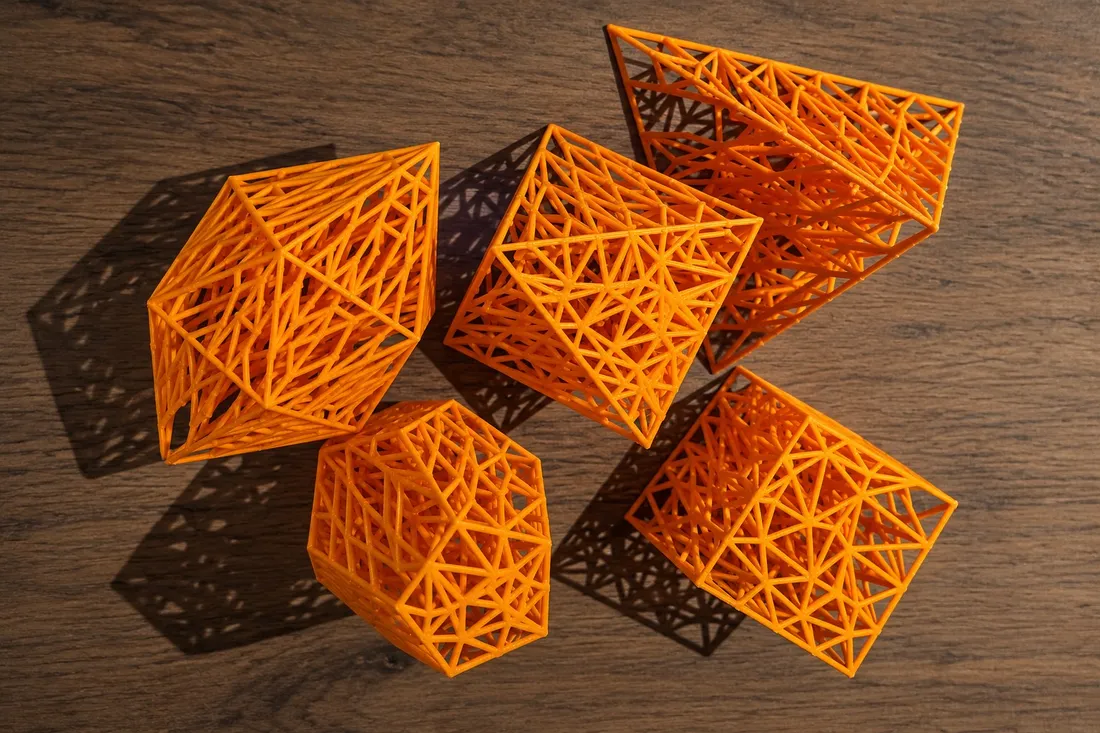
Ever wanted a 3D-printed Klein bottle for your desk? You can’t have one. Not a real one, anyway. A Klein bottle doesn’t fit in three dimensions; the surface has to pass through itself, and that’s the part you’re not supposed to notice. I wanted the part you’re supposed to notice: the edges, thinned out until you can see the whole shape at once. Too bad it turns into spaghetti when you try to print it.
Loading…
Drag to orbit · scroll to zoom

I have a glass Klein bottle, but it just sits on a shelf because it’s super fragile. But a squishy Klein bottle made of TPU — now that would be a neat toy for me and my kids. So let’s print one. If you have a look at the render, the colors give the problem away: the rods are colored by their own angle, and many of them are close to horizontal. PLA tends to turn into a stringy mess if you print it below about 45° from horizontal, and TPU is even less forgiving: it wants about 60°. Here we’ve got edges that are almost horizontal.
I had the idea that maybe there is a triangulation of the Klein bottle that you can print easily: stretch the shape a bit, and then have an algorithm push the rods closer to vertical. But things get tricky near the top. Maybe they get easier with a simpler shape. Let’s look at the sphere instead:
Loading…
Drag to orbit · scroll to zoom

Same problem — many rods are close to horizontal. And it doesn’t go away. A finer mesh doesn’t help either: subdividing makes the rods shorter, not steeper. A rod on the surface is always close to tangential, and near the top and bottom the sphere’s normal is nearly vertical, so every rod up there has to be near horizontal. On the bottom we can fix this with supports, but at the top it’s a lost cause.
When is a shape printable
At this point I gave up on having a squishy Klein bottle, but I was still determined to get a cool looking mathematical shape out of it. Based on what we have learned, we can make two adjustments:
- Shapes that gradually shift from vertical to horizontal don’t work -> let’s try polytopes, which skip the gradual transitions
- The top is always going to be a problem with hollow shapes -> so let’s fill the inside with more lattice.
So given a polytope, we want to find a lattice that:
- Has rods and nodes lying in the faces of the polytope, with roughly constant density, so the surface reads clearly
- Fills the inside of the polytope with a lattice of roughly equal density
Then we need some extra rules to make it printable without supports. For PLA we want to avoid rods below about 45° from horizontal, and every rod needs to be supported from something below. There is one exception: bridges. If you span a horizontal gap of 10 mm or so, you don’t need anything under it, as long as both ends are well supported.
We can encode this as some additional rules for the lattice:
- A rod needs to be either:
- above from horizontal, or:
- exactly horizontal (with effectively no margin for error), with a maximum length of 10 mm (unless it is on the build plate)
- A node in the lattice needs to be supported from below by at least two non-horizontal rods.
We pick as the critical angle for the material. For PLA it is roughly 45°, and we use 48° to leave a bit of room for error.
For a polytope to print, at a minimum all of its faces need to be either horizontal or steep enough: the normal needs to be more than from vertical. A horizontal face at the bottom is fine, since it sits on the build plate.
Is that enough? I think so. I didn’t prove it, but it does work in practice. I started with the Platonic solids and stretched them where needed so their faces were steep enough. Then I just had to find the right lattice. And not just ANY lattice that satisfies those rules — I wanted one that looked organic but geometric.
The lattice algorithm
We want an organic arrangement that satisfies the printability rules. The core idea is this: start with a random arrangement of nodes, push the nodes in the right direction until they are printable, and then connect them with rods.
A random arrangement by itself can have a very organic look, but it’s not printable, and it may have very short or very long rods. I think an arrangement where the nodes are roughly equally spaced, with no regular pattern to it, is perfect.
Ignoring printability for a second: if you take a random arrangement and let the points repel each other, you already end up with something roughly equally spaced, without a regular pattern. The force between two nodes is proportional to how much closer they are than a fixed cutoff distance , and zero beyond it:
We also need to keep in mind the shape of the object. To make sure the surface is clearly defined, we seed points on the edges and faces of the polytope. Points on an edge slide along that edge, points on a face slide around inside that face, and the polytope’s own edges are rods in the lattice. On a slanted face we place the points from the bottom up, each one so that it already has two parents inside the same face. Nothing inside the solid can hold an overhanging face up, so it has to hold itself up, and that’s how.
But we can’t ignore printability. We also want the rods to have a minimum length of 8 mm and a maximum of 28 mm, for aesthetic reasons. The most important rule is that every node has two parents: nodes below it, at least above horizontal, at a distance between those two limits. So for every node we look for the two nodes most likely to be good parents, and add a smooth penalty that makes them parents.
These forces are applied iteratively. Each step, every node moves a little depending on the forces on it, and the best parents are recomputed. Repeat 900 steps, and you hopefully converge on something nice.
At this point we have nodes, but not a lattice. We could connect every pair that satisfies the printability rules, but then nodes end up with very high degree, which is not the look I was going for. So instead we pick the rods with a mixed-integer program, keeping the degree of every node between 3 and 6 if we can. The MIP puts a cost on each rod: it wants rods of about 15 mm, and it prefers rods near the critical angle. Anything shallower than the critical angle is not allowed, horizontal bridges being the one exception. Rods can’t touch, and every node on a face needs a couple of rods lying in that face, so the surface reads as a surface. Then it finds the cheapest set of rods. The solution depends a lot on how you assign the costs, so it took some tweaking to get right.
This gets us pretty far, but then the rubber hits the road. Here are some of the issues I ran into, and what I did about them:
- Isotropic spacing. Repulsion on its own spreads nodes out evenly, but parents are easier to find if nodes line up vertically. So vertical distance counts for a bit less than horizontal, which pushes nodes further apart vertically and makes the pair above you steeper.
- Horizontal faces. The bottom face sits on the build plate, so it’s exempt. The top face is a ceiling: it only gets horizontal rods of at most 10 mm, and every node on it needs a steep post from the inside.
- Face nodes with nothing under them. Sometimes a node on an upward face has no inside node underneath it to support it. So there’s an anchor term in the forces that pulls the nearest inside node directly underneath the face node.
- Nodes without enough parents. If the MIP leaves a node without enough support, we move it to a spot where it can be supported and solve again. If it’s still stuck, we add a rod by hand, even if that pushes a node over the degree limit. A few nodes can still end up unsupported.
- Almost-horizontal rods. A rod at 4.9° is a legal bridge and one at 5.1° isn’t, so at the end every rod that’s close to horizontal is snapped to exactly horizontal.
- The dodecahedron and icosahedron. Regular, they aren’t printable, so they get stretched until their faces are steep enough. No longer truly Platonic, but they still look cool.
This is still a simplification. Most of the small details are battle scars: run the algorithm on a solid, find something wrong with the lattice, and add a fix for that particular failure mode. Even then it’s not perfect, but I’m happy with the results.
Loading…
Drag to orbit · scroll to zoom
Loading…
Drag to orbit · scroll to zoom
Loading…
Drag to orbit · scroll to zoom
Loading…
Drag to orbit · scroll to zoom
Loading…
Drag to orbit · scroll to zoom
They printed first try, which was nice, and they look great. They’re on my desk now, and I have no idea what to do with them, but they do look cool.
I made this whole thing with a lot of help from an AI, which really let me focus on the algorithm and on how to make it look cool, instead of on actually doing the implementation, which would just take up a lot of time that I don’t have. I wanted to explore the intersection between AI and art and engineering, and I think I got that. Thinking together with an AI about an algorithm, and making something cool out of it, is very satisfying, and I’m super happy with the result.
If you want to poke at the code, it’s on GitHub, but fair warning, it’s pretty rough: RikVoorhaar/printable-surfaces .
Keep reading
29th of March, 2022
Linear least-squares system pop up everywhere, and there are many fast way to solve them. We'll be looking at one such way: GMRES.
10th of March, 2022
We recently made a paper about supervised machine learning using tensors, here's the gist of how this works.
26th of September, 2021
A lot of data is naturally of 'low rank'. I will explain what this means, and how to exploit this fact.

29th of August, 2021
Parsing and editing Word documents automatically can be extremely useful, but doing it in Python is not that straightforward.

18th of October, 2026
Generating a book-specific Danish dictionary from an EPUB and installing it on a Kobo e-reader.

15th of January, 2025
I made an array programming language as a language extension to Rust

1st of August, 2024
Self-hosting your own cloud services not only saves money, it is also a great way to learn

7th of October, 2023
In my first dive into Rust, I implemented an unscented Kalman filter in and made it 20x faster than the equivalent Python implementation.

1st of May, 2023
I made an interactive dashboard for this website, and here is the story of how I did it.

26th of February, 2023
Read this blog post if you're curious what I worked on during my PhD!

31st of May, 2021
Finally, let's look at how we can automatically sharpen images, without knowing how they were blurred in the first place.
2nd of May, 2021
Deconvolving and sharpening images is actually pretty tricky. Let's have a look at some more advanced methods for deconvolution.
9th of April, 2021
In order to automatically sharpen images, we need to first understand how a computer can judge how 'natural' an image looks.

13th of March, 2021
Deconvolution is one of the cornerstones of image processing. Let's take a look at how it works.

13th of February, 2021
I have 15 years worth of email traffic data, let's take a closer look and discover some fascinating patterns.

9th of November, 2020
We use exams to determine how much a student knows, but exams aren't perfect. How can we estimate the uncertainty in students' exams scores?

26th of August, 2020
Cross validation is extremely important, but how should we choose the size of our validation and test sets?

12th of August, 2020
I use last.fm to track my music listening. Let's look at my data to discover how my musical preferences evolve over time.
10th of August, 2020
Normally distributed data is great, but how do you know whether your data is normally distributed?

20th of June, 2020
Judging in figure skating is biased. Let's use data science to figure out just how bad the issue is.