A dictionary generated from the book you are reading
October 18, 2026
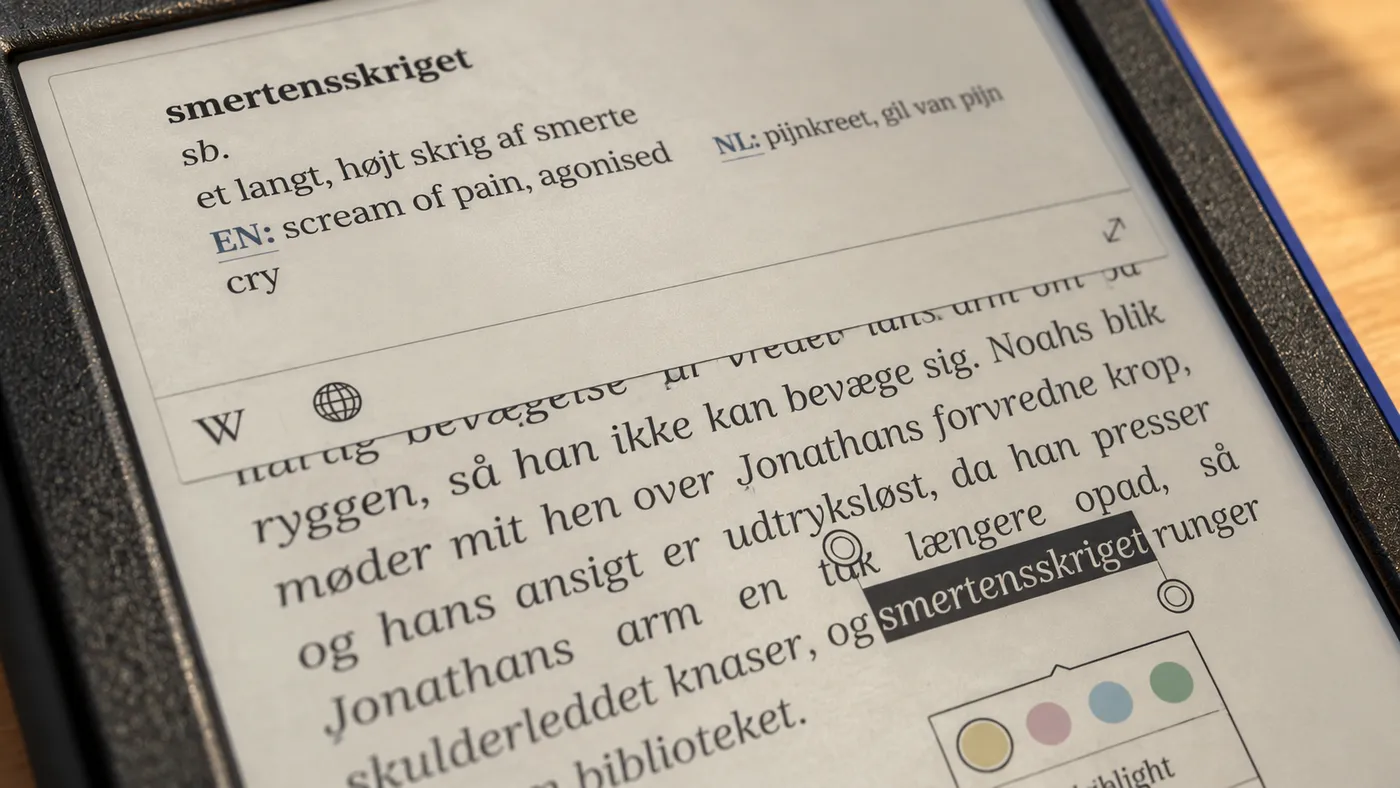
The problem
I finally made the courageous decision to start reading books in Danish. I want to improve my Danish, and reading the news already works fine, so folding Danish literature into my daily routine should grow my vocabulary fast.
There was just one problem: Kobo doesn’t ship a Danish dictionary. There’s no official one at all, and the ones you can find to install are basically Wiktionary. For Dutch or French, Wiktionary is amazing; for Danish it’s just not a great resource, and whatever word you tap in a novel usually isn’t there. Reading without a dictionary is hell, and reaching for my phone breaks the flow. I wanted something quick and easy.
So I had an idea: build a small project that generates a dictionary from the words that actually occur in the book. Some napkin math suggested it would be cost-effective, certainly cheaper than the e-book itself.
The idea
Here’s the idea in full. Take an EPUB (as long as it has no DRM) and extract every word in it. Many of those are inflections of the same word, so you can lemmatize them down to a smaller set (more on that later).
Then, for each word, write a prompt containing the Danish word plus the contexts where it actually occurs in the book: up to a maximum, ideally the sentence before, the sentence itself, and the sentence after. Force the model to produce structured output, and generate a dictionary entry from that. The context does a lot of the work. A model doesn’t reliably remember what every Danish word means, but even a little evidence of how a word is used is often enough to infer the meaning and translate it. It’s boring, which is the point: EPUB in, one JSON dictionary entry per lemma out.
From there, a program called dictgen (I don’t know exactly what it does) turns the entries
into the HTML that the e-reader understands.
The good part is that it genuinely works: every word in the book has an entry. I can’t stress enough how useful that is. Even a very good English dictionary wouldn’t manage it. Danish is full of compounds, and you can try to decompose them yourself, but that’s not always an option or obvious, and no dictionary contains every possible compound. Knowing the actual book changes the calculus. Even a fairly long book might only have 10,000–20,000 unique words, which you can work through in batches.
And because I’m bilingual in Dutch and English, the dictionary can be personalised: each entry has a Danish definition plus both a Dutch and an English gloss. That’s fantastic for language learning, and you won’t find it in a normal dictionary. That kind of personalisation is only possible with AI.
A very short dictionary primer
A dictionary has a few moving parts. First, the lemma: the dictionary form of a word. Verbs get conjugated and nouns and adjectives get inflected, but the dictionary lists the base form: tage, not tager, tog or taget.
Then there’s the surface form: the exact string that appears in the book, the thing you actually tap. The dictionary essentially needs an entry for every surface form, so a lookup is just a map from surface to dictionary entry.
That’s exactly why the lemma matters here. An EPUB only gives you surface forms. You could generate an entry for each surface directly, but you’d produce the same word many times over (tager, tog, taget) at extra cost, and the entries wouldn’t necessarily agree with each other. Collapsing the surfaces into lemmas first, and then generating one entry per lemma that actually occurs in the book, is an optimisation rather than a requirement. It just saves money and makes the dictionary more consistent.
And an entry consists of one or more senses: the distinct meanings of the word. Gift, for example, can mean both “poison” and “married”.
How I built it
I’ve been quiet on this blog, but in the meantime I’ve gotten a lot of practice at agentic coding. I won’t claim to be an expert, but I’ve found a workflow that works well for me.
I started by discussing the problem with Perplexity. For a project like this, a search-based engine that also has access to strong models is the best starting point, because it covers a lot of blind spots. I didn’t know how a dictionary is constructed, how to read an EPUB, or whether this was even possible, so my first question was simply: can this be done at all? The answer was yes. Once I understood the terminology, I hammered out a rough plan with Perplexity.
Then I moved to a coding agent, through OpenRouter. I don’t vibe-code often enough to justify a Claude subscription, and this is cheap. DeepSeek V4.1 Flash, for example, is very cheap and very capable; it’s roughly as capable as the absolute frontier from six months ago, which is kind of insane.
I start with an overview of all the todos, no details, in an HTML plan that I can easily inspect and edit, and that contains all the context an agent needs. Then I grill it, first to make sure there are no blocking decisions and that the whole process is understood. The plan is divided into phases, each one a logical unit that can be executed on its own, like a ticket. For each phase I grill until I’m satisfied that it says exactly what to do, and then execute. From that point on, especially for something no more complex than this, it’s pretty hands-off.
A few decisions mattered. My first lemmatizer was Stanza, and it was unreliable: it would often take a surface form and produce a completely different lemma. Han became ha, an expression of laughter. Then I found the DDO full-form list , a large, curated set of inflected-form → lemma pairs based on Den Danske Ordbog. It’s much higher quality than rule-based lemmatization for Danish, and it worked far better, giving a neat entry for almost every word. Stanza is still there as a backup for the words DDO doesn’t cover. For other languages the available lemmatizers may be perfectly adequate; for Danish, maybe not.
I also tried adding cognates (Dutch is close to Danish, so a cognate is much easier to remember) and morphology (word composition), because both should help a learner. The models just aren’t good at that: they hallucinate, or produce nothing useful, especially when a word has several senses. So I removed both.
Picking a model
For the model choice, I asked Perplexity which models made sense. It suggested a few cheap ones: a Qwen model, GPT-6 Luna, and Claude Haiku, all under $0.20 per million input tokens. Output is cheap too, because every response is a small structured JSON object. And most of the input is the same for every word (only the contexts change), so it’s largely cacheable.
Then I ran a bake-off. The idea is simple: take the same 200 words, have each model produce its entries, then ask a judge model to compare the outputs pairwise and pick the better one. From those comparisons you compute something like an ELO score, and the model with the higher score is better at the task. I used Mistral Large 4 as the judge, on the hunch that it would be good at European languages. That’s not evidence-based, but it gave a good enough signal. Haiku won consistently, which makes sense since it was the newest of the three. That is what I went with, and I’m quite happy with the results.
The result
Here’s what two entries actually look like:
pludselig vise sig eller komme frem, ofte uventet
bøje sig eller gemme sig hurtigt ned for at undgå noget
legetøjsfigur, der forestiller et menneske
dukke covers three senses across two parts of speech. The one-off compound is even
better:
en regnbue lavet af farveblyanter, her en splittet række af farvede streger eller tegning
“Coloured-pencil rainbow.” It occurs exactly once in the book, and no general dictionary would ever include it. That’s the point: the dictionary covers the words the book actually uses, about 7,500 headwords expanded to roughly 9,900 look-up forms.
The JSON behind these entries
dukke — input (the task sent to the model)
{
	"lemma": "dukke",
	"poses": ["NOUN", "VERB"],
	"frequency": 33,
	"sent_count": 33,
	"observed_forms": ["duk", "dukke", "dukkede", "dukker", "dukket"],
	"contexts": [
		{
			"id": "s009804",
			"text": "„Hvad hvis horror vacui dukker op mellem to meteorstorme?",
			"surface": "dukker"
		},
		{
			"id": "s010312",
			"text": "Hvem det end var, som kastede den brandbombe, må de have vidst, at vi ville dukke op.",
			"surface": "dukke"
		},
		{
			"id": "s007031",
			"text": "Og så mærkeligt er det vel heller ikke, at der dukker en mus op på et bibliotek?",
			"surface": "dukker"
		},
		{
			"id": "s006898",
			"text": "Måske er tegningerne bare dukket op et andet sted?",
			"surface": "dukket"
		},
		{
			"id": "s007118",
			"text": "„Og sagde du ikke, at myren først dukkede op, da du underskrev tegningen?“",
			"surface": "dukkede"
		},
		{
			"id": "s009504",
			"text": "I kan bruge den, hvis I af en eller anden grund ikke har nået at indstille kompasset, når horror vacui dukker op.“",
			"surface": "dukker"
		},
		{
			"id": "s006154",
			"text": "Da jeg nærmer mig huset, er der ikke dukket nogen gode idéer op.",
			"surface": "dukket"
		},
		{
			"id": "s006768",
			"text": "Hverken fru Holm eller pedellen er dukket op på biblioteket, da vi træder ind ad døren og ser ham ligge på knæ foran den slidte sofa.",
			"surface": "dukket"
		},
		{
			"id": "s002747",
			"text": "„Jeg ved ikke, hvem I er, men det virker alt andet end tilfældigt, at I dukker op ud af det blå og spørger efter min far.“",
			"surface": "dukker"
		},
		{
			"id": "s009813",
			"text": "„Så hvis horror vacui kun kan dukke op, når der er mange stjerneskud … skal vi i hvert fald sørge for at være tæt på hinanden, hver gang der er en meteorstorm?“",
			"surface": "dukke"
		},
		{
			"id": "s002381",
			"text": "Linus dukker frem bag en reol med en fysikbog i hånden.",
			"surface": "dukker"
		},
		{
			"id": "s007315",
			"text": "Jeg ser det ikke dukke op, men der ligger et stykke knækbrød på dynen ved siden af mit lår, da jeg endelig tør kigge væk fra blokken.",
			"surface": "dukke"
		},
		{
			"id": "s004179",
			"text": "Der lyder skridt inde i stuen, og Alban dukker op i døråbningen ud til entréen.",
			"surface": "dukker"
		},
		{
			"id": "s010512",
			"text": "Josefs ansigt dukker op på væggen.",
			"surface": "dukker"
		},
		{
			"id": "s000522",
			"text": "Tanken får angsten fra drømmen til at dukke op igen, et glimt af is i hjertekulen.",
			"surface": "dukke"
		}
	]
}
dukke — output (the entry the model returned)
{
	"senses": [
		{
			"pos": "VERB",
			"definition_da": "pludselig vise sig eller komme frem, ofte uventet",
			"equivalents_en": ["appear", "turn up", "show up"],
			"equivalents_nl": ["opduiken", "verschijnen"],
			"label": "dukke op"
		},
		{
			"pos": "VERB",
			"definition_da": "bøje sig eller gemme sig hurtigt ned for at undgå noget",
			"equivalents_en": ["duck"],
			"equivalents_nl": ["bukken", "duiken"],
			"label": null
		},
		{
			"pos": "NOUN",
			"definition_da": "legetøjsfigur, der forestiller et menneske",
			"equivalents_en": ["doll"],
			"equivalents_nl": ["pop"],
			"label": null
		}
	],
	"expressions": [
		{
			"da": "dukke op",
			"en": "turn up, show up",
			"nl": "opduiken"
		}
	],
	"note": "The noun sense is not supported by the supplied sentences; only the verb 'dukke op' is attested, so the noun sense is included as a best-effort fallback from common usage.",
	"schema_version": "2",
	"lemma": "dukke",
	"frequency": 6,
	"sent_count": 6,
	"observed_forms": ["dukke"]
}
farveblyantsregnbue — input
{
	"lemma": "farveblyantsregnbue",
	"poses": ["NOUN"],
	"frequency": 1,
	"sent_count": 1,
	"observed_forms": ["farveblyantsregnbue"],
	"contexts": [
		{
			"id": "s001309",
			"text": "Jeg tænker på det lysende glasstykke fra drømmen og på den spaltede farveblyantsregnbue, som ligger i min taske.",
			"surface": "farveblyantsregnbue"
		}
	]
}
farveblyantsregnbue — output
{
	"senses": [
		{
			"pos": "NOUN",
			"definition_da": "en regnbue lavet af farveblyanter, her en splittet række af farvede streger eller tegning",
			"equivalents_en": ["colored pencil rainbow", "pencil rainbow"],
			"equivalents_nl": ["kleurpotlood-regenboog"],
			"label": null
		}
	],
	"expressions": null,
	"note": null,
	"schema_version": "2",
	"lemma": "farveblyantsregnbue",
	"frequency": 1,
	"sent_count": 1,
	"observed_forms": ["farveblyantsregnbue"]
}
The whole thing took about four hours, and about $3 in tokens to produce a dictionary for one more book. That’s the marginal cost, not the total: the project as a whole cost closer to $6, because I ran the pipeline twice and paid a judge model during the bake-off. Some entries are imperfect, with an odd sense here and a missing name there, but every word I’ve tapped so far has had an entry.
Installing it is trivial: drop the .zip into the .kobo/dict folder on the Kobo, and it
works immediately. That fast loop is also what made it cheap to iterate on the dictionary’s
styling a couple of times.
Reading with it
I’m reading a Danish book, and with a dictionary that actually covers it I look up maybe two or three words per page. That’s few enough that it doesn’t pull me out of the story, which is the whole point. I genuinely enjoy reading it; it doesn’t feel like a chore.
And that’s the result I actually care about: I can read books in Danish now. I like fantasy and science fiction, and I found Nanna Foss’s Spektrum through a Perplexity recommendation. I had started with the first Silo novel translated into Danish, but the level was way too high. Spektrum is Danish YA science fiction and fantasy, aimed at a younger audience. I might have preferred something more mature, but the writing is good and it’s exactly the right level for me. More than enough.
So my recommendation: once you’re around B2/C1, start reading books for entertainment. Find something at the right level, read it on an e-reader, and use a dictionary that has entries for everything you need. If you already speak several languages, glosses in more than one of them are genuinely helpful too, since they make words easier to remember.
Keep reading

15th of January, 2025
I made an array programming language as a language extension to Rust

1st of August, 2024
Self-hosting your own cloud services not only saves money, it is also a great way to learn

7th of October, 2023
In my first dive into Rust, I implemented an unscented Kalman filter in and made it 20x faster than the equivalent Python implementation.

1st of May, 2023
I made an interactive dashboard for this website, and here is the story of how I did it.

26th of February, 2023
Read this blog post if you're curious what I worked on during my PhD!
29th of March, 2022
Linear least-squares system pop up everywhere, and there are many fast way to solve them. We'll be looking at one such way: GMRES.
10th of March, 2022
We recently made a paper about supervised machine learning using tensors, here's the gist of how this works.

26th of September, 2021
A lot of data is naturally of 'low rank'. I will explain what this means, and how to exploit this fact.
29th of August, 2021
Parsing and editing Word documents automatically can be extremely useful, but doing it in Python is not that straightforward.

31st of May, 2021
Finally, let's look at how we can automatically sharpen images, without knowing how they were blurred in the first place.
2nd of May, 2021
Deconvolving and sharpening images is actually pretty tricky. Let's have a look at some more advanced methods for deconvolution.
9th of April, 2021
In order to automatically sharpen images, we need to first understand how a computer can judge how 'natural' an image looks.

13th of March, 2021
Deconvolution is one of the cornerstones of image processing. Let's take a look at how it works.
13th of February, 2021
I have 15 years worth of email traffic data, let's take a closer look and discover some fascinating patterns.

9th of November, 2020
We use exams to determine how much a student knows, but exams aren't perfect. How can we estimate the uncertainty in students' exams scores?

26th of August, 2020
Cross validation is extremely important, but how should we choose the size of our validation and test sets?
12th of August, 2020
I use last.fm to track my music listening. Let's look at my data to discover how my musical preferences evolve over time.
10th of August, 2020
Normally distributed data is great, but how do you know whether your data is normally distributed?

20th of June, 2020
Judging in figure skating is biased. Let's use data science to figure out just how bad the issue is.